



請將裝置改以直向瀏覽,以獲得最佳效果。
Sustainable Energy and Resource Management
- The Bank has established "Environmental Resource and Energy Use Management Policy" and has successively obtained certifications for ISO 14001 Environmental Management System, ISO 50001 Energy Management System, and ISO 46001 Water Efficiency Management System. Additionally, the Bank joined the MOENV's "Green Office" initiative and actively implemented indicators, including "saving energy and resources", "source reduction", "green procurement", "environmental greening", and "promotion and initiatives". These efforts have demonstrated tangible results, with the Bank receiving the National Enterprise Environmental Protection Award – Silver Award from MOENV for two consecutive years (the 6th and 7th awards) as of September 10, 2025.
Certification of Domestic and International Environmental Sustainability Standards
To implement environmental sustainability, the Bank has proactively introduced multiple international environmental standards since 2015, setting targets to review implementation effectiveness annually. Regularly verification are conducted by third-party inspections to obtain verification statements, ensuring that the Bank minimizes its environmental impacts and hazards while conductin operations. In particular, for the environmental and energy management systems, drawing on past experience, has expanded scope from the head office building to all domestic operating sites, fulfilling corporate social responsibility and contributing to environmental protection.
ISO 14001 Environmental Management System(Scope: All domestic operational sites and offices)ISO 50001 Energy Management System(Scope: All domestic operational sites and offices)ISO 46001 Water Efficiency Management System(Scope: The Taipei Building of the Head Office)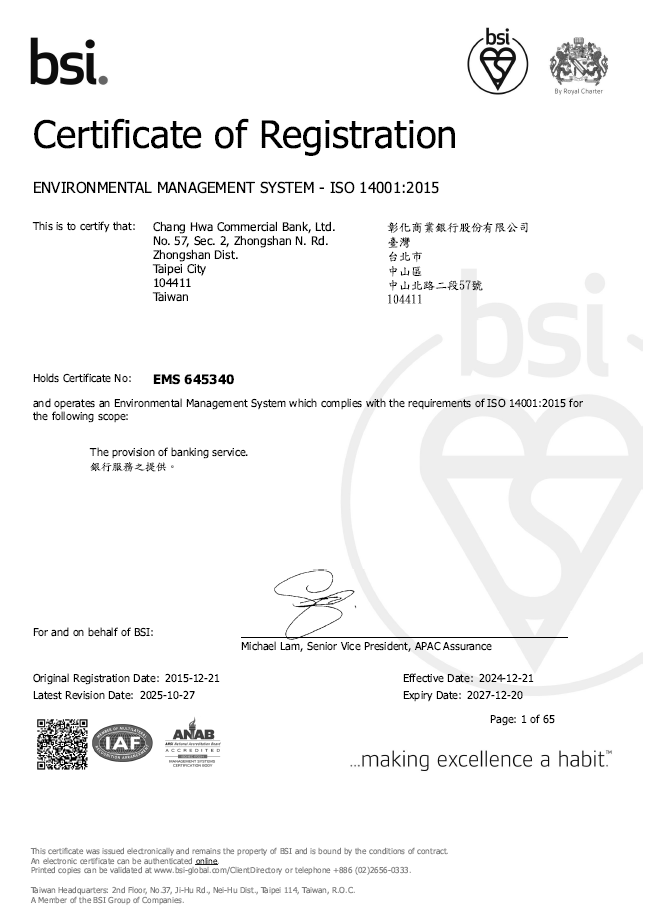
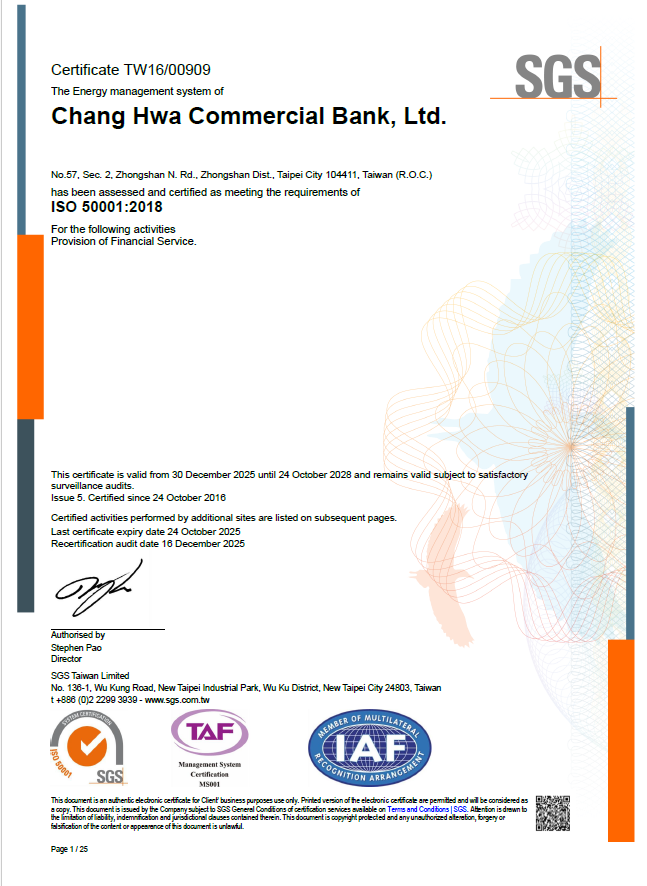
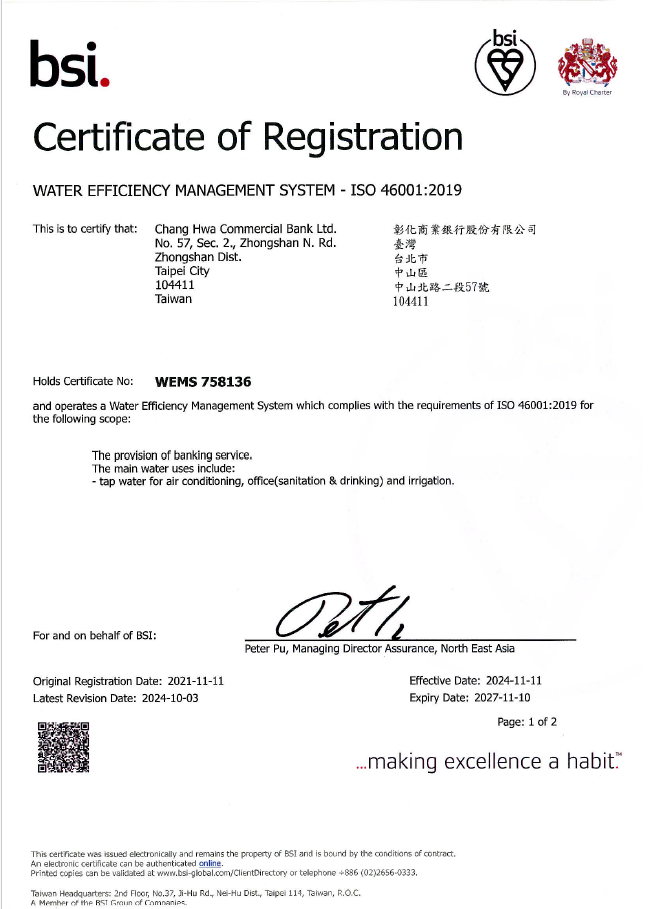
Since 2015, the Bank has used the Head Office as a demonstration site to introduce the ISO 14001 Environmental Management System, establishing a systematic environmental management framework to ensure operations comply with environmental regulatory requirements and to mitigate environmental impacts. Beginning in 2024, the scope of implementation was expanded to all domestic operational sites. During the implementation period, all sites passed audits by third-party inspection agencies and obtained verification statements.In 2016, the Bank took the lead by introducing the ISO 50001 Energy Management System at the Head Office building, establishing energy baselines, setting energy conservation targets, and continuously improving energy efficiency. During implementation, the Bank continuously maintained the validity of the certificate through thirdparty inspection , and leveraged its operational experience in energy management to extend measures such as equipment replacement and energy efficiency management to branches. By 2024, the scope of ISO 50001 implementation covered all domestic operational sites.To mitigate the impacts of climate change and water scarcity, the Bank proactively introduced the ISO 46001 Water Efficiency Management System in 2021, systematically tracking water resource usage, promoting tailored water management actions, and identifying water-saving opportunities to improve water efficiency performance. Considering that water consumption from the Bank's operations (as a financial service provider) has a lower environmental impact, the implementation scope focuses primarily on the Head Office building, with annual verifications conducted to maintain the validity of the certificate.
Energy and Resource Management Performance Energy and Resource Management Performance
- Fuel Reduction Measures
- In 2025, fuel consumption decreased by 32.65% compared to 2020.
- To implement energy conservation and carbon reduction while reducing air pollution, daily gasoline and diesel fuel consumption is incorporated into management. Employees are encouraged to carpool in official vehicles or take public transportation when conducting business off-site. Additionally, for newly leased official vehicles or contract renewals, hybrid vehicles are adopted to enhance vehicle energy efficiency. When replacing or purchasing new scooters, the Bank encourages all units to prioritize electric scooters approved by the Ministry of Economic Affairs.
- ★Highlights and Achievements
- For newly leased official vehicles or those with expiring leases, the Bank is transitioning to hybrid vehicles across four phases. By the end of 2025, a total of 255 hybrid vehicles have been delivered, with full transition of all official vehicles to hybrids expected by 2028. In addition, a comprehensive inventory of old fuel-powered scooters was conducted. Starting in 2024, priority has been given to replacing fuel-powered scooters over 10 years old with electric scooters, with 69 vehicles replaced by the end of 2025.
- Electricity Saving Measures
- In 2025, electricity consumption decr eased by 16.48% compared to 2020.
- To effectively improve energy management efficiency, the Bank independently developed an online energy management platform in 2022, where branches regularly submit activity data to verify and track energy usage in real time. Based on the operational experience with energy management systems, the Bank promotes energysaving measures such as replacing aging air conditioning and lighting equipment, adopting high-efficiency or energy label-certified products, controlling air conditioning temperatures, and reducing unnecessary lighting.
- ★Highlights and Achievements
- By 2023, all operational sites of the Bank fully adopted LED lighting equipment. Currently, aging air conditioning units are progressively being replaced with level 1 and 2 energy-efficiency models, while laser printers (toner cartridge types) are being transitioned to inkjet models in phases.
- Water Conservation Measures
- In 2025, water consumption decr eased by 16.34% compared to 2020.
- To improve water resource efficiency, the Bank first introduced a water efficiency management system in 2021, passing the verification by the British Standards Institution (BSI) and becoming the first enterprise in Taiwan to obtain BSI ISO 46001 certification. Combined with measures such as "prioritizing the procurement of water-saving certified products," "establishing a water resource management data reporting platform," and "installing water meters on major water-consuming equipment for regular monitoring," the Bank continues to improve its water reduction performance year by year.
- ★Highlights and Achievements
- Following the implementation of the ISO 46001 water efficiency management system at the Head Office (Taipei Building), procedures such as water usage review, inventory of major water-consuming equipment, and identification of water-saving opportunities were conducted. Water meters were installed on major water-consuming equipment for regular monitoring, establishing a water baseline to systematically track water consumption.
- Waste Reduction Measures
- In 2025, total waste generation decreased by 2.43% compared to the previous year.
- To achieve sustainable resource utilization and ensure proper waste disposal, the Head Office (Taipei Building) adopts proactive waste management by promoting energy-saving and waste-reduction activities, actively implements source management through waste sorting and recycling, while regularly recording waste volumes. Since the main sources of the Bank's waste are general trash and recyclable waste generated by employees, the reduction strategy begins with general waste statistics, formulating reduction measures, and setting reduction targets. The scope of waste statistics is gradually being expanded, prioritizing high-volume waste categories. Additionally, advocacy for waste sorting and management continues in order to raise recycling rates.
- ★Highlights and Achievements
- In response to circular economy policies and adhering to the spirit of "cherishing resources and reducing waste at the source", we have promoted second-hand item exchange and reuse activities for three consecutive years. Through the transfer and donation of pre-owned items, the lifespan of products is extended, reducing resource waste. Giving these items a new life and directing them to those in need has achieved a reuse rate of about 70%.
- Paper Saving Measures
- To align with environmental sustainability policies and implement energy conservation and carbon reduction, the Bank has introduced various digital systems to replace traditional paper-based operations, including online official document systems, electronic forms, online learning networks, and intranet announcements. After the launch of these systems, operations such as dispatching and receiving official documents, approval processes, form submissions, training materials, and announcing important news, can be conducted online. This effectively reducing paper consumption and shortening administrative processing time, achieving both the eco-friendly benefits of a paperless environment and enhanced administrative efficiency.
Awards and Recognitions
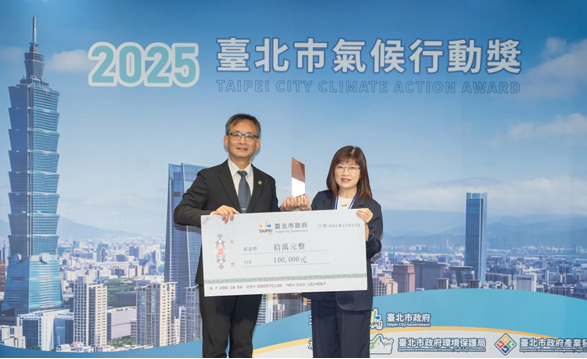
Awarded
-
Positively responding to global climate challenges and fulfilling its responsibility toward net-zero transition in the financial sector, the Bank participated in the "2025 Taipei City Climate Action Award" organized by the Taipei City Government for the first time. The Bank received two prestigious honors: the "Silver Award" and the "Net Zero Green Lifestyle Excellence Award." on December 24, 2025, Deputy Mayor of Taipei City Chang Wen-Te served as the award presenter, which were accepted by Executive Vice President Teng Hsiu-Chuan on behalf of the Bank, which fully demonstrates the Bank's outstanding achievements in promoting climate action, greenhouse gas reduction and netzero sustainable development.
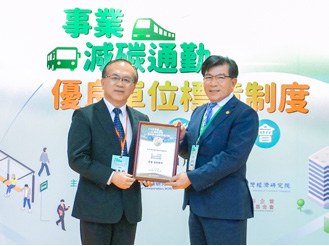
Awarded Gold Level of Enterprise Carbon Reduction Commuting Excellence Label by the Ministry of Transportation and Communications
-
Implementing diversified carbon reduction strategies and actions, the Bank launched an employee green commuting program . In participating in MOTC's inaugural "Enterprise Carbon Reduction Commuting Excellence Label" program, the Bank received the "Gold Level " certification , recognizing its concrete achievements in promoting low-carbon commuting and energy conservation . On November 21 , 2025, Deputy Ministry of Transportation and Communications Chen Yen-Po presented the award, which was accepted by Executive Vice President Chung Chi-Min on behalf of the Bank, demonstrating our firm commitment to ESG and net-zero transition.
- Building on internal operational resource management achievements, the Bank further aligns its sustainability initiatives with government net-zero transition policies by actively participating in external initiatives, including the following key actions:
- Proactively joined the Ministry of Environment's "Net-Zero Green Lifestyle Alliance," jointly demonstrating our commitment to transitioning toward a green lifestyle.
- The Head Office and 185 branches joined the "Green Office" initiative, responding to 37 measures across 5 major indicators - saving energy and resources, reduction at the source, green procurement, environmental greening, and promotion and initiatives. As a result, performance in overall power consumption, fuel consumption, and green procurement improved compared to the previous year, jointly creating a green, eco-friendly office environment and contributing to the planet.
- Joined as an "Environmental Protection Point" member and purchased green points. Combining these with various ESG activities, the Bank distributed green point rewards to share the eco-point concept, integrating environmental awareness into employees' daily habits while encouraging colleagues to practice green consumption.
Increasing Renewable Energy Utilization
The Bank increases the renewable energy utilization through green energy procurement and the establishment of solar branches. In 2025, the Bank enhanced its capacity of green energy supply and completed 2 additional solar branches, bringing the renewable energy utilization rate to 10.07%.
Green Energy Supply
Since 2022, the Bank has successively signed contract with renewable energy suppliers to supply green electricity to the Taipei Building, our Head Office, and the IT Building. In 2025, the total amount of green electricity supplied reached 2.51 million kWh, representing an increase of appr oximately 0.89 million kWh compar ed to 2024.
-
Green Energy Supply (kWh)
2022 2023 2024 2025Taipei Building100,000110,000 120,000 1,012,761 IT Building- 227,672 1,500,000 1,500,000 Total Amount100,000 337,672 1,620,000 2,512,761
Establishment of Solar Powered Branches
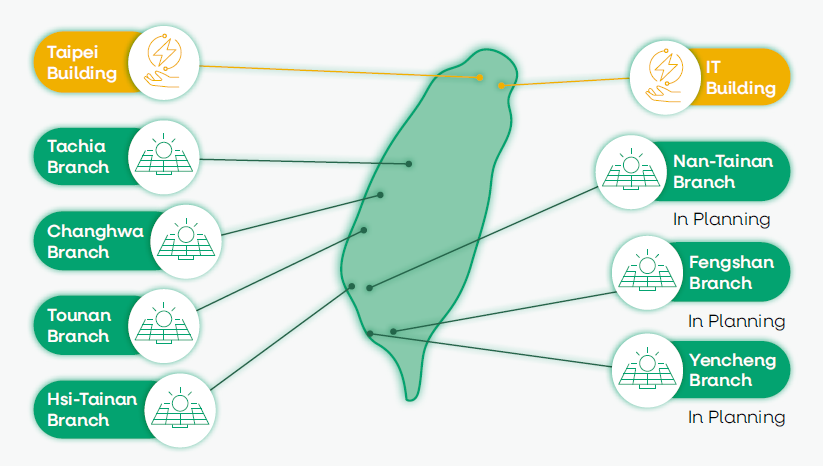
Since 2023, the Bank has successively completed rooftop solar power installations at the Changhwa Branch (installed capacity of 18.24 kW) and the Hsi-Tainan Branch (installed capacity of 21.66 kW). In 2025, the Bank further commissioned solar systems at the Tounan Branch (installed capacity of 18.4 kW) in August and the Tachia Branch (installed capacity of 50.6 kW) in September. Total electricity generated by the Bank's solar power systems reached 62,927kWh in 2025. Looking ahead, rooftop solar power installation projects are being planned for the Nan-Tainan, Yencheng, and Fengshan Branch.
-
Power Generation (kWh)202320242025Changhwa Branch3,41324,95424,165Hsi-Tainan Branch-16,29624,244Tounan Branch--3,793 (Note 1)Tachia Branch--10,725 (Note 2)Total Amount3,41341,25062,927
Note 1 : The solar power generation facility at Tounan Branch was commissioned in August 2025. - Note 2 : The solar power generation facility at Tachia Branch was commissioned in September 2025.
-
The current goal for the Chengtung Branch, the Chiencheng Building, the Yuanli Branch, and the Taoyuan Branch, all involved in urban renewal projects, are all striving to achieve "Green Building Certification." The Peimen Branch and the Tianjin Street dormitory were completed and successfully obtained the Silver-level Green Building Certification by incorporating environmentally friendly elements such as green landscaping, water conservation, energy efficiency, and water resource recycling.
-
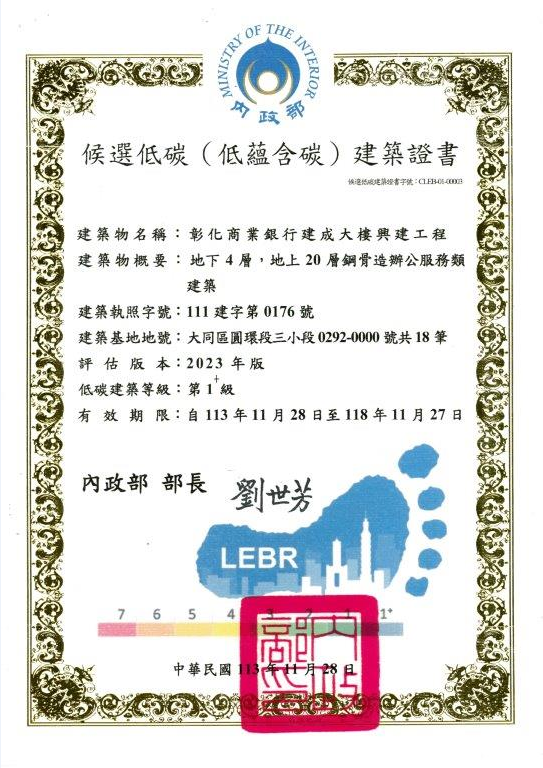
In addition, seven major construction elements of the Chiencheng Building incorporated low-carbon design strategies―including the main structural framework, exterior cladding, translucent exterior windows and curtain walls, opaque curtain walls, interior partitions, indoor flooring, and outdoor paving, achieving a carbon footprint reduction (CFR) of 30.5%. The project was evaluated and approved by the Ministry of the Interior's review committee as meeting the criteria for a low-carbon building and was awarded the Low-Carbon Level 1+ label. It is the first office building in Taiwan's financial industry to receive a Candidate Low-Carbon (Low Embodied Carbon) uilding Certificate.